Bedding · Materials and construction
How to Evaluate Vispring Bedding Materials and Construction
A mattress is a small landscape of fibers, springs, and carefully joined layers. To understand how a Vispring bed may feel, look beyond broad promises of comfort: trace the materials from the sleep surface inward, notice how the support system is built, and consider what everyday care will ask of you.
Published November 21, 2026
Bedding descriptions can read like inventories from distant places: wool from the Shetland Islands, horsetail prepared in Austria, cotton, cashmere, alpaca, silk. Each name suggests a particular texture or origin, but a material list alone cannot tell you whether a mattress suits your body, room, or habits. The more useful questions are practical. Where does each fiber sit? What role does it play in the layered construction? How might the combination affect surface feel, moisture, warmth, and upkeep?
This guide offers a method for evaluating Vispring bedding without treating natural fibers as automatic guarantees of better sleep. It explains the basic properties and construction details worth comparing, and shows how to read a detailed specification with a clear eye. Comfort remains personal: the same mattress can feel different to sleepers with different builds, preferred positions, sensitivities, and bedroom conditions.
Start with the whole construction, not a single fiber
A mattress is a system. Its surface upholstery, support core, cover, edge, and foundation all contribute to the experience. A soft-feeling top layer may cushion the shoulder, while deeper components help resist compression. A responsive filling may recover after pressure is removed; a spring unit may respond to weight in a different way. These functions overlap, but they are not interchangeable.
When comparing Vispring bedding, begin by finding the complete materials list and the order of its layers. Ask whether the description identifies the fillings separately or simply groups them under terms such as “natural upholstery.” Note whether the spring unit is described by its architecture, whether the cover is specified, and whether border construction is explained. A precise account makes it easier to understand what the bed contains and what the makers intend each component to do.
Then connect the specification to your own priorities. If you tend to feel warm, focus on how the surface may manage moisture and how the room is ventilated. If you want a more yielding first impression, examine the upper upholstery and the way it is secured. If you value a stable perimeter, look for information about edge reinforcement. These details help frame a comparison; they cannot replace trying a mattress when that is possible.
Read natural fibers by function
Natural fibers vary in feel and behavior, and the same fiber can contribute differently depending on its amount, location, preparation, and combination with other materials. The word “natural” describes an origin or material class, not a universal performance rating. A useful evaluation therefore asks what the fiber is doing in the construction rather than assuming that its name answers every comfort question.
Wool: a versatile layer in the mix
Wool is commonly used in mattress upholstery because it can provide loft and absorb moisture. In a layered bed, it may form part of the surface padding or sit deeper in the construction. Its effect depends on how it is prepared and blended, how much is used, and how firmly the layers are compressed. A description naming wool is informative, but the placement and construction provide the fuller picture.
Temperature comfort is not a single material trait. Room temperature, bedding, sleepwear, humidity, and personal physiology all matter. Wool’s moisture-handling properties may be relevant to someone who wants a less clammy sleep surface, but no fiber can guarantee that a sleeper will feel cool. Treat claims about temperature as a reason to investigate the design, not as a promise of an individual result.
Cashmere and alpaca: fine fibers for surface character
Cashmere and alpaca are often associated with soft, fine fibers. In mattress descriptions, they may be blended with other upholstery materials rather than used as a complete layer on their own. Their relevance is therefore tied to the surrounding construction: how the blend is arranged, how much space it occupies, and what other materials provide resilience or support.
A soft fiber blend does not necessarily mean the entire mattress will feel soft. The spring unit, the depth and density of upholstery, and the sleeper’s weight all influence how far the body settles. When reviewing a specification, distinguish the tactile quality suggested by a fiber name from the overall firmness or support of the finished bed.
Silk and bamboo: consider position and moisture
Silk and bamboo may be included near the surface, where a maker may intend them to contribute to the feel of the upholstery and the handling of humidity. Their position matters. Fibers close to the ticking meet the body and bed linens more directly than materials placed nearer the spring system. If a product description explains the sequence, use it to understand how the design is organized rather than treating each material as an isolated feature.
The term “bamboo” can refer to different material forms and processing routes in bedding. If the precise fiber type or processing is important to you, look for a clear specification rather than relying on a shorthand material name. Likewise, silk in a blend should be understood as one element in a layered surface, not as a guarantee of a particular temperature or feel.
Horsetail: resilience within the upholstery
Long-strand horsetail is used in some traditional mattress constructions for its springy character. In a Vispring description, hand-opened Austrian horsetail is presented as a resilient layer that can contribute to recovery after pressure. Its role is different from that of the coil unit beneath it: it belongs to the upholstery, while the springs form the primary mechanical support system.
When a specification gives a place of origin and a preparation method, record those details as part of the construction story. They can help distinguish one type of filling from another. Still, the meaningful comparison is how the material is integrated with the adjacent layers and how the finished bed feels under your own weight.
Understand spring architecture and support
Pocket springs are individual coils held in fabric pockets, allowing them to respond more independently than a single connected spring structure. In a hand-nested arrangement, springs are positioned and assembled as part of a deliberate system. The number of springs may be listed, but a count alone is not a reliable measure of comfort. Spring dimensions, tension, arrangement, mattress size, upholstery, and overall construction all shape the result.
Some Vispring models use multiple spring layers. A layered unit can be understood as several interacting levels of response, rather than one row doing all the work. Check how the manufacturer describes each layer and whether the mattress offers different spring tensions. Terms such as soft, medium, firm, and extra firm are useful starting points, but they are not standardized measurements across all makers. A “medium” in one design may not feel identical to a “medium” in another.
Try to separate support from surface softness. Support concerns how the mattress holds the body in a comfortable, balanced position; surface feel describes the first impression and the way upholstery yields. A plush top can sit above a relatively supportive core, while a firmer surface may still provide pressure relief if its layers distribute weight appropriately. Neither label, by itself, predicts how your shoulders, hips, and back will feel through the night.
Look closely at the details that hold layers in place
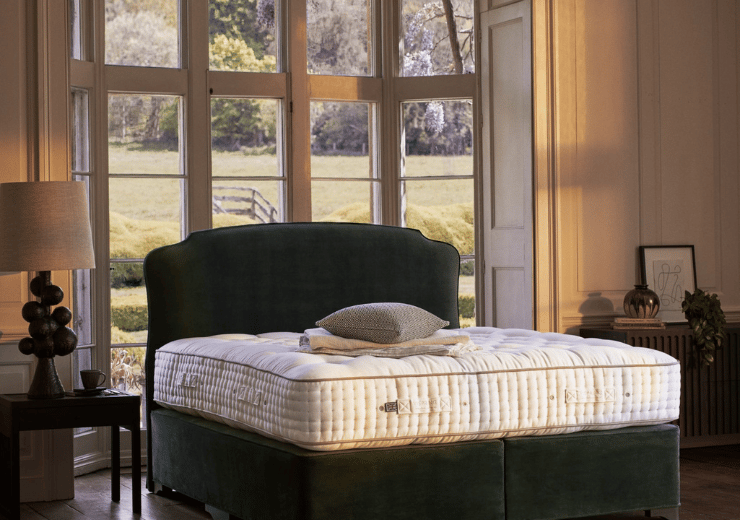
Construction is also about how materials are secured. Hand-tufting, for example, uses ties that pass through the mattress to compress and hold the upholstery layers at intervals. This helps keep fillings in position as the bed is used. The spacing, materials, and workmanship of the tufts can be useful details to note when comparing traditional builds.
The border is another important area. Side-stitching can help stabilize the mattress edge and connect the border to the spring system. If you sit on the edge often or use the full width of the bed, ask how the perimeter is supported. Handles may assist with moving or rotating a mattress, but they are not necessarily designed to carry its full weight; consult the care instructions before using them for lifting.
Air vents, where present, are construction features intended to support airflow through the sides. Their presence does not mean the mattress will regulate temperature independently of the room and bedding. Instead, treat vents as one part of a broader design that may influence how air moves around the mattress.
A worked example: tracing the layers of Vispring Opulence
The Vispring Opulence Mattress offers a detailed example of how to read a layered specification. Its description lists silk and bamboo near the ticking, followed by cashmere and alpaca, then hand-opened long-strand horsetail. Shetland wool and cotton are also included around the spring system. Rather than reading this as a simple ranking of “better” and “lesser” materials, trace the sequence and consider the different jobs the layers may perform.
The product description also identifies a triple-layer hand-nested calico pocket-spring construction, several spring-tension options, woollen tufts, and hand side-stitching along the border. Together, those details tell a more complete story than a list of luxury fibers alone. They describe upholstery, support architecture, and methods for holding the components in place. Before making any decision, check the current specification for the exact size and configuration you are considering, and ask for clarification if figures or terminology differ between documents.
This example illustrates a useful rule: evaluate the sequence, construction, and stated options as a whole. A long list of materials may sound impressive, but it is the relationship among those materials—and the way the mattress responds to you—that matters in use.
Temperature regulation is a whole-bedroom question
A sleep surface is part of a larger environment. Mattress fibers can influence how the surface handles moisture and how it feels against sheets, but room temperature, ventilation, duvet weight, pajamas, and individual heat sensitivity remain influential. If you often wake feeling too warm, observe the entire setup before attributing the problem to one material.
Consider how the cover and ticking feel, whether the mattress has an airflow feature, and what type of protector and sheets are used. A thick protector or heavy duvet can change the surface experience. So can a warm bedroom with limited air movement. When comparing bedding materials, look for specific descriptions of construction and care rather than relying on broad labels such as “cooling” or “breathable.”
If you are particularly sensitive to temperature or moisture, note your observations for several nights: room conditions, bedding layers, and when discomfort occurs. This simple record can help you identify whether the challenge is mainly the mattress, the bedding above it, or the broader sleep environment.
Care requirements are part of the material choice
A mattress is not usually cleaned like a bedsheet. Its fillings and structure may require careful handling, and water or harsh cleaning products can cause damage. Before buying, find the maker’s guidance on airing, rotation, stain response, and suitable support. Follow the instructions for the specific model rather than assuming that all natural-fiber mattresses share the same routine.
A removable cover, if a design has one, does not automatically mean the entire cover is machine washable. Check the care label and written instructions. For a non-removable surface, a well-fitting protector can help limit direct exposure to perspiration and spills, but the protector itself should also be chosen with the mattress’s care guidance in mind.
Rotating a mattress may be recommended for some designs, while flipping may not be appropriate for others. A one-sided mattress with a designated comfort surface should not be flipped unless the manufacturer explicitly says it can be. Confirm the correct orientation and frequency, and use any provided handles only as directed. Regular care is less about imposing a universal routine than about preserving the construction as it was intended to be used.
A practical checklist for comparing Vispring bedding
Before making a comparison, gather the specification for each model and answer these questions:
- Which fibers are listed, and are they described as individual layers or blends?
- Where are the materials positioned, from the ticking to the spring unit?
- What kind of spring construction is used, and are different tensions available?
- How are the upholstery layers secured—for example, by tufting or other stated methods?
- What details are given about the border, side-stitching, handles, or vents?
- What support does the mattress require, and does the foundation meet the instructions?
- What are the care instructions, including rotation, airing, and stain treatment?
- Can you test the mattress for long enough to assess your position, pressure points, and temperature comfort?
Write down your own preferences before comparing product language. Do you sleep mainly on your side, back, or stomach? Do you prefer a cushioned surface or a more immediate, stable feel? Do you share the bed, and is movement transfer a concern? The answers are more useful than trying to translate an unfamiliar fiber name directly into a verdict.
Separate evidence from appealing language
Words such as “luxury,” “natural,” and “handcrafted” can describe a brand’s positioning, but they are not measurements. Look for verifiable specifics: named materials, layer order, construction method, spring options, mattress depth, and written care instructions. If a claim is important to your decision, ask what it means in practice and whether it applies to the exact size or version you are considering.
Certifications and origin statements may provide useful information, but they should be read precisely. A material’s stated origin does not by itself establish how the finished mattress will feel or how it will perform. Similarly, a natural-fiber construction does not remove the need to consider durability, cleaning, room conditions, and personal comfort. Clear specifications encourage a more grounded comparison than general claims alone.
The most useful comparison is the one you can feel
Evaluating Vispring bedding is an exercise in joining details: the character of the fibers, their position in the upholstery, the spring architecture beneath them, and the workmanship that keeps the layers together. Those details help explain what a mattress is made to do. They do not tell you, with certainty, how your body will respond.
Use specifications to narrow your questions, then test the surface if you can. Lie in your usual sleeping position, allow time for the mattress to respond, and notice whether pressure builds at the shoulder or hip. Consider whether your spine feels comfortably supported and whether changing position is easy. Ask about the foundation and the care routine before the decision is final. A thoughtful assessment turns a list of materials into a practical picture of everyday use—and lets comfort remain what it is: personal, lived experience.